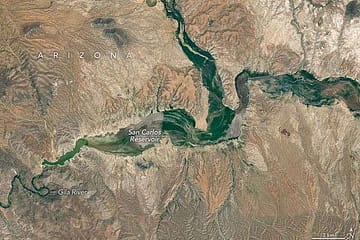
Ongoing megadrought in the US Southwest

Background: “… American Southwest. Since 2000, the region — which includes Arizona, New Mexico, California, Utah, Colorado and parts of northern Mexico — has endured a historic “megadrought,” or a period of severe dryness that persists for decades. Scientists say it’s the driest this region has been in 1,200 years. Scientists point to two factors causing the drought — rising temperatures and declining precipitation. Heat from human-caused climate change creates a…

See more

The U.S. just had its hottest month in recorded history, surpassing Dust Bowl record

by Jeff Masters and Bob Henson, Yale Climate ConnectionsAugust 10, 2026 Those who deny or dismiss U.S. climate change have hit a Waterloo moment of sorts. The nation just experienced its hottest month in more than 130 years of analysis, which breaks a record that had stood since the infamous Dust Bowl of the 1930s. For the 48 contiguous states, the July 2026 average of…

See more

The US is seeing stronger storms, so why are droughts getting worse?

David Boutt, UMass Amherst (from The Conversation) About two-thirds of the U.S. is in some stage of drought in late spring 2026, yet at the same time the country has been seeing more intense downpours. It might seem contradictory, but both are symptoms of rising global temperatures. The reason has to do with the water cycle. Water influences every aspect of our lives through a…

See more

“Global Warming Has Accelerated Significantly”

Featured article: *Foster, G., & Rahmstorf, S. (2026). Global warming has accelerated significantly. Geophysical Research Letters, 53(5), e2025GL118804. [PDF] [Cited by] “Recent record-hot years have caused discussion over whether global warming has accelerated. Previous analysis found acceleration (i.e., increase in warming rate) has not yet reached a 95% confidence level, given natural temperature variability. We remove the estimated influence of three main natural variability factors:…

See more

2025 was hotter than it should have been – 5 influences and a dirty surprise offer clues to what’s ahead

Michael Wysession, Washington University in St. Louis (from The Conversation) The past three years have been the world’s hottest on record by far, with 2025 almost tied with 2023 for second place. With that energy came extreme weather, from flash flooding to powerful hurricanes and severe droughts. Yet, by most indicators, the planet should have been cooler in 2025 than it was. So, what happened,…

See more

Extreme and unusual weather: United States Midwest — impacts, consequences

Immediate impacts: Immediate and longer-term consequences for people, agriculture, wildlife, etc.: Extreme weather and climate change: the connections and impacts Where are all the birds? What is a flash drought? An earth scientist explains Climate change and agriculture: damage to crops Increasing frequency of drought and decreasing yields for soybeans Higher temperatures will lead to additional crop damage from insects Climate change is intensifying the water…

See more

Do you care? We need education, resolve, and action

WMO report documents spiralling weather and climate impacts (March 2025). Land and water degradation, food and water supply shortages, drug-resistant infections from overuse of antibiotics, overuse of pesticides and disease, sea level rise affecting coastal areas, microplastics/single-use plastic pollution on land and in the oceans, rapidly melting ice at the Poles, heatwaves, droughts, extreme rainfall, powerful hurricanes, and more … leading to people and animals…

See more

Why some storms brew up to extreme dimensions in the middle of America – and why it’s happening more often

Shuang-Ye Wu, University of Dayton (from The Conversation) A powerful storm system that stalled over states from Texas to Ohio for several days in early April 2025 wreaked havoc across the region, with deadly tornadoes, mudslides and flooding as rivers rose. More than a foot of rain fell in several areas. As a climate scientist who studies the water cycle, I often get questions about…

See more

Extinction and climate change

Earth’s climate is changing rapidly. No, it is not a hoax, not a projection for the future, not a scare tactic from whatever political or advocacy group that you or your favorite politician may not like. In our lifetimes, it has changed–generally growing warmer and often dryer, with daily weather more prone to extremes–winds, rain, snow, cold, heat, more destructive storms leading to more extensive…

See more
What is an atmospheric river?

What is an atmospheric river? A hydrologist explains the good and bad of these flood-prone storms and how they’re changing

Qian Cao, University of California, San Diego (from The Conversation) A series of atmospheric rivers is bringing the threat of heavy downpours, flooding, mudslides and avalanches to the Pacific Northwest and California this week [early 2024]. While these storms are dreaded for the damage they can cause, they are also essential to the region’s water supply, particularly in California, as Qian Cao, a hydrologist at…

See more
Creative Commons License
This work is licensed under a Creative Commons Attribution 4.0 International License.