

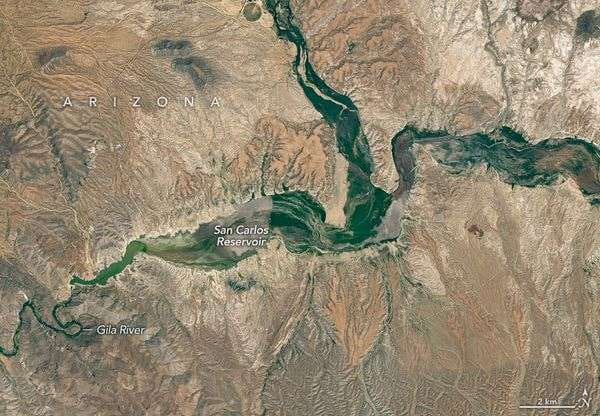
Background:
“… American Southwest. Since 2000, the region — which includes Arizona, New Mexico, California, Utah, Colorado and parts of northern Mexico — has endured a historic “megadrought,” or a period of severe dryness that persists for decades. Scientists say it’s the driest this region has been in 1,200 years.
Scientists point to two factors causing the drought — rising temperatures and declining precipitation. Heat from human-caused climate change creates a thirsty atmosphere that is more effective at drying out the landscape … As for the lack of rain … a study published in 2025 suggests something far more ominous: Humankind has disrupted a naturally occurring climate cycle in the Pacific Ocean that historically ushered episodes of wet weather into the Southwest.”
From: Ogasa, Nikk. (2026). Will the U.S. megadrought ever end? ScienceNews, 208(10).
Sources:
*Klavans, J. M., DiNezio, P. N., Clement, A. C., Deser, C., Shanahan, T. M., & Cane, M. A. (2025). Human emissions drive recent trends in North Pacific climate variations. Nature, 644(8077), 684-692. [Cited by]
“The Pacific decadal oscillation (PDO)—the leading pattern of climate variability driving changes over the North Pacific and surrounding continents—is now thought to be generated by processes internal to the climate system. According to this paradigm, the characteristic, irregular oscillations of the PDO arise from a collection of mechanisms involving ocean and atmosphere interactions in the North and tropical Pacific. Recent variations in the coupled ocean–atmosphere system, such as the 2015 El Niño, ought to have shifted the PDO into its positive phase. Yet, the PDO has been locked in a consistent downward trend for more than three decades, remanding nearby regions to a steady set of climate impacts. Here we show that the main multidecadal variations in the PDO index during the twentieth century, including the ongoing, decades-long negative trend, were largely driven by human emissions of aerosols and greenhouse gases rather than internal processes. This anthropogenic influence was previously undetected because the current generation of climate models systematically underestimate the amplitude of forced climate variability. A new attribution technique that statistically corrects for this error suggests that observed PDO impacts—including the ongoing multidecadal drought in the western United States—can be largely attributed to human activity through externally forced changes in the PDO. These results indicate that we need to rethink the attribution and projection of multidecadal changes in regional climate.”
*Williams, A. P., Cook, B. I., & Smerdon, J. E. (2022). Rapid intensification of the emerging southwestern North American megadrought in 2020–2021. Nature Climate Change, 12(3), 232-234. [PDF] [Cited by]
“A previous reconstruction back to 800 ce indicated that the 2000–2018 soil moisture deficit in southwestern North America was exceeded during one megadrought in the late-1500s. Here, we show that after exceptional drought severity in 2021, ~19% of which is attributable to anthropogenic climate trends, 2000–2021 was the driest 22-yr period since at least 800. This drought will very likely persist through 2022, matching the duration of the late-1500s megadrought.”
*Todd, V. L., Shanahan, T. M., DiNezio, P. N., Klavans, J. M., Fawcett, P. J., Anderson, R. S., Jiménez-Moreno, G., LeGrande, A. N., Pausata, F. S. R., Thompson, A. J., & Zhu, J. (2025). North Pacific ocean–atmosphere responses to Holocene and future warming drive Southwest US drought. Nature Geoscience, 18(7), 646-652. [PDF] [Cited by]
“The Southwest United States is experiencing severe and persistent drought, although uncertainties regarding the causes limit our ability to predict changes in water availability. The severity of the current drought has been attributed to a combination of warming and natural changes in atmospheric circulation, suggesting that current rainfall deficits may improve as natural oscillations reverse sign. Here we use new leaf-wax stable isotope reconstructions and simulations for the mid-Holocene (6 thousand years ago) and demonstrate that moderate warming of the Northern Hemisphere can produce drought over the Southwest United States through an ocean–atmosphere response originating in the North Pacific. The patterns of ocean warming and rainfall change resemble the negative phase of the Pacific Decadal Oscillation, indicating that this mode can be excited by external forcings. A similar response to warming is evident in future projections, leading to sustained winter precipitation deficits through the mid-twenty-first century. However, the magnitudes of past and current precipitation deficits associated with this North Pacific response are systematically underestimated in models, possibly due to a weak coupling of ocean–atmosphere interactions. Projections may also underestimate the magnitude of this precipitation response to changes in the North Pacific, leading to greater drought risk in this already water-poor region.”
*Hogan, D., & Lundquist, J. D. (2024). Recent Upper Colorado River Streamflow Declines Driven by Loss of Spring Precipitation. Geophysical Research Letters, 51(16). [PDF] [Cited by]
“Colorado River streamflow has decreased 19% since 2000. Spring (March-April-May) weather strongly influences Upper Colorado River streamflow because it controls not only water input but also when snow melts and how much energy is available for evaporation when soils are wettest. Since 2000, spring precipitation decreased by 14% on average across 26 unregulated headwater basins, but this decrease did not fully account for the reduced streamflow. In drier springs, increases in energy from reduced cloud cover, and lowered surface albedo from earlier snow disappearance, coincided with potential evapotranspiration (PET) increases of up to 10%. Combining spring precipitation decreases with PET increases accounted for 67% of the variance in post-2000 streamflow deficits. Streamflow deficits were most substantial in lower elevation basins (<2,950 m), where snowmelt occurred earliest, and precipitation declines were largest. Refining seasonal spring precipitation forecasts is imperative for future water availability predictions in this snow-dominated water resource region.”
For additional information, search Science Primary Literature.
Questions? Please let me know (engelk@grinnell.edu).
